
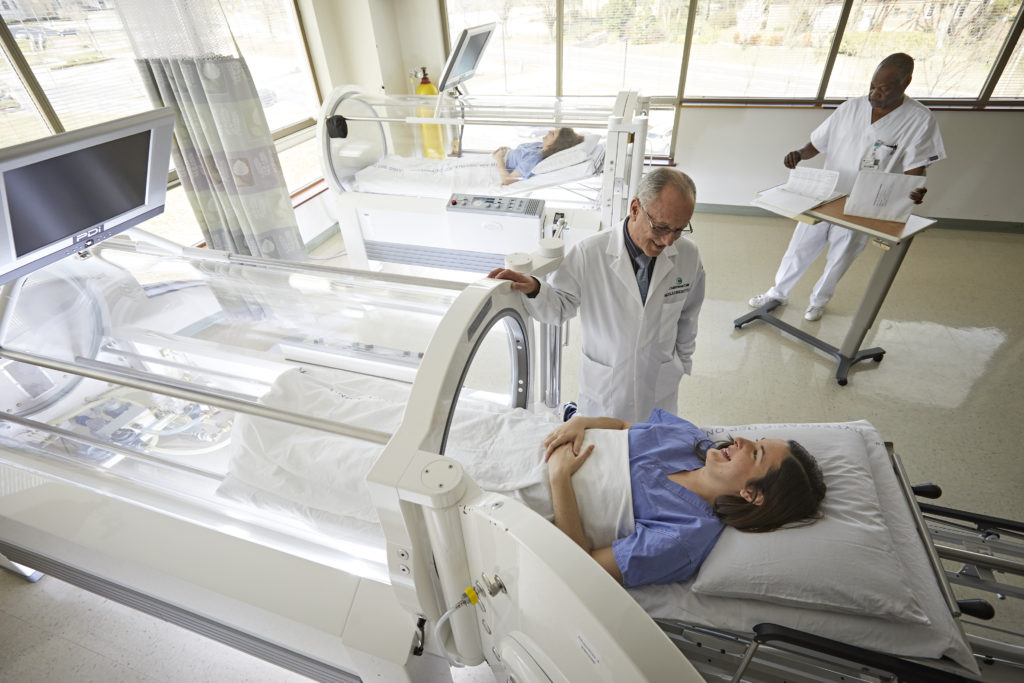
Hyperbaric oxygen therapy is a treatment in which a person breathes pure oxygen inside a pressurised chamber, allowing far more oxygen than usual to dissolve into the blood and reach the body’s tissues. In the setting of wound healing, this oxygen-rich state supports the biological processes the body depends on to rebuild damaged skin and tissue, particularly where blood flow is reduced.
How hyperbaric oxygen therapy works
Under increased pressure, oxygen dissolves directly into the blood plasma rather than relying only on red blood cells. This means oxygen can reach areas where circulation is impaired, such as the margins of a slow-healing wound. By raising the amount of oxygen available to the tissues, hyperbaric oxygen therapy helps create the conditions cells need to repair themselves (Slater et al., 2022).
Oxygen, angiogenesis and tissue repair
Wound repair is oxygen dependent. The formation of new blood vessels, known as angiogenesis, along with fibroblast activity and collagen synthesis, all rely on adequate oxygen. Research indicates that raising tissue oxygenation can stimulate growth factors and support the development of the collagen framework on which new blood vessels form (De Wolde et al., 2021).
Applications in chronic and complex wounds
In clinical research, hyperbaric oxygen therapy has been studied as an addition to standard wound care rather than a replacement for it, with the proposed benefit centred on improved tissue oxygenation (Thom, 2011). Whether it is appropriate for any particular wound is a clinical decision made with a treating doctor. This article is general information about the science, not a treatment recommendation or an offer to treat any specific condition.
Important considerations
Hyperbaric oxygen therapy should always be delivered in an accredited facility under appropriate medical supervision. It is not a substitute for standard wound management, and suitability varies from person to person. Anyone considering hyperbaric oxygen therapy for a wound should discuss it with a qualified healthcare professional first.
Conclusion
Hyperbaric oxygen therapy offers a well-tolerated way to increase the oxygen available to healing tissue, supporting angiogenesis, collagen formation and tissue repair. Used as part of a broader care plan and delivered in accredited settings, it may have a role in the management of chronic and complex wounds.
Reference List
- De Wolde, S. D., Hulskes, R. H., Weenink, R. P., Hollmann, M. W., & Van Hulst, R. A. (2021). The effects of hyperbaric oxygenation on oxidative stress, inflammation and angiogenesis. Biomolecules, 11(8), 1210. DOI: https://doi.org/10.3390/biom11081210
- Slater, G., O’Malley, M., Slater, T., & Sambo, T. (2022). Hyperbaric oxygen therapy: An overview. Journal of Regenerative Biology and Medicine. Retrieved from: https://www.researchgate.net/publication/360995927_Hyperbaric_Oxygen_Therapy_An_Overview
- Thom, S. R. (2011). Hyperbaric oxygen: Its mechanisms and efficacy. Plastic and Reconstructive Surgery, 127(Suppl 1), 131S–141S. DOI: https://doi.org/10.1097/prs.0b013e3181fbe2bf
Disclaimer: This blog is for informational purposes only and should not be considered medical advice. Please consult with your healthcare provider for any questions or concerns regarding your health.